
TwinMeta has introduced the CPTI (Creative Power Type Indicator), a self-report assessment designed to help creators understand their individual creative working styles in the AI era. Available at genesistwinker.xyz, CPTI explores four dimensions: ideation, expression, creative goals, and work process. Rather than ranking creativity through scores or productivity, the assessment focuses on how individuals generate ideas, express themselves, and approach creative tasks.TwinMeta has also published a related research paper on SSRN, outlining CPTI’s theoretical foundation and development process. The study reviewed 39 academic sources and developed 20 preliminary assessment items. Currently in its early research stage, CPTI will require further empirical studies to evaluate its reliability and validity. The initiative aims to encourage greater self-awareness and a broader understanding of human creativity in an increasingly AI-driven environment.
Lewes, DE, United States, 27th Oct 2026 – TwinMeta has introduced the CPTI (Creative Power Type Indicator), a self-report assessment designed to help creators better understand their individual working styles, and has published a related research paper on the academic research-sharing platform SSRN.
CPTI examines how individuals approach creativity across four dimensions: ideation, expression, creative goals, and work process. The assessment is available at genesistwinker.xyz.
CPTI was developed around a central question: how should human creativity be understood in the age of AI?
As AI increasingly generates text, images, and video, the human role in deciding what to create and what meaning to give it is becoming even more important. However, judging creativity only by the quality of the final output or the speed of production may not fully capture the different processes and choices involved in how individuals create.
Rather than assigning a single score to determine whether someone is more or less creative, CPTI explores the approaches individuals tend to prefer when generating ideas, expressing them, and developing their work.
The assessment is intended to help people understand differences in creative style without ranking one approach above another. For example, someone who explores a wide range of possibilities may work differently from someone who prefers to develop a single idea in greater depth.
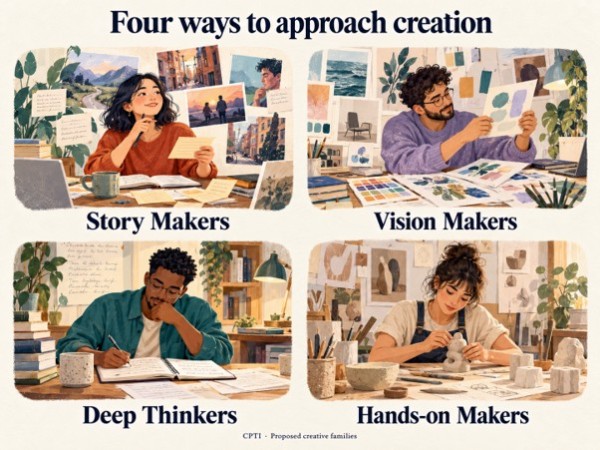
CPTI is structured around four areas: Ideation Tendency, which examines how individuals explore ideas; Expression Tendency, which looks at how ideas are translated into concrete forms; Creative Goal Tendency, which considers the purpose behind creative work; and Work Process Tendency, which explores how individuals approach experimentation and completion.
Through these dimensions, CPTI is designed to encourage creators to reflect on their own choices and creative processes.
The research paper published on SSRN outlines the theoretical foundation and development process behind CPTI. The study reviewed 39 academic sources and used them to develop 20 preliminary assessment items.
The project is currently at an early, literature-based research stage. The reliability and validity of the assessment are expected to be evaluated through future empirical studies.
Rather than simply asking creators to produce more, CPTI focuses on giving individuals an opportunity to understand how they create.
It represents an effort to explore creativity in the AI era not only through productivity, but also through the different perspectives, preferences, and working styles that shape each person’s creative process.
More information about the CPTI creative tendency assessment is available at genesistwinker.xyz.
Media Contact
Organization: TWINMETA INC
Contact Person: Yongil Choi
Website: http://twinmeta.xyz
Email: Send Email
Contact Number: +821033588983
Address: Coastal Highway Lewes DE
Address 2: 16192
City: Lewes
State: DE
Country: United States
Release id: 50203
View source version on King Newswire:
TwinMeta Introduces CPTI Creative Tendency Assessment, Publishes Related Research on SSRN

Disclaimer: The views, suggestions, and opinions expressed here are the sole responsibility of the experts. No Funds Economy journalist was involved in the writing and production of this article.